

‘Ode To Joy’ is a well-known melody from the prelude to the fourth movement of Beethoven’s Ninth Symphony. Today this melody appears in the official anthem of the European Union.
Here are some links to articles if you would like to know more about Ludwig van Beethoven’s melody, the poem, ‘Ode To Joy’, by German poet, playwright, and historian Friedrich Schiller, and some history regarding this poem and melody.
In addition, this is a great melody for beginning guitar players to learn. I will explain four reasons why you should include this song in your music practice sessions, and later your guitar repertoire.
This is the introduction to a series of articles on how to play ‘Ode To Joy’ in various ways and keys, in order to learn several guitar playing techniques and skills and explore the guitar fretboard. Stay tuned for additional articles.
Simple melody: Only 5 notes
‘Ode To Joy’ uses only the first five notes of a Major Scale, also known as the “do re mi” scale. So that would be these notes: do, re, mi, fa, so. The 5th scale note (“so”) appears as both a high sounding “so” and low sounding “so”. So, technically speaking, there are six notes, but the “so” appears in two different places.
When you play ‘Ode To Joy’ in the key of C, you play these notes: C, D, E, F and G. The “so” note in key of C is the G note.


When you play ‘Ode To Joy’ in the key of G, you play these notes: G, A, B, C and D. The “so” note in key of G is the D note.


I will include guitar tablature and audio for ‘Ode To Joy’ in both keys in subsequent articles.
Contiguous Melody Notes: In Both Directions
The majority of the melody notes follow the scale, meaning they are consecutive notes. The melody goes up and down, but as you play the melody you are either playing the next lower note or next higher note in the scale. Thus, this is a fun way to practice your Major Scale while you are playing a song.
Here is an excerpt from the first two measures in key of C. The melody starts at note E and goes up, then down. All the while the notes follow the scale notes.
| E E F G | G F E D | …
Like as mentioned above, there is one exception to the contiguous melody notes. At the end of the 3rd musical phrase (measure 12), the lower “so” note is played. At that point, there is a larger melody jump in the descending direction (notes “re” to low “so”).
Melody Phrase Repetition: Makes Learning Easier
This melody has 16 measures. There are four musical phrases of four measures each. Once you learn the first phrase, you can easily learn the second phrase.
The first two phrases are nearly identical, except that the last measures are different; the ending cadences are different. That means the phrases end on different notes, and thus also end on different chords. If you had a friend playing chords along with you, then you would clearly hear the difference.
The third phrase is unique, and adds some musical interest after hearing the first two similar sounding phrases.
Here’s where the repetition helps with learning this tune: The fourth phrase is identical to the second phrase. Once you know phrase two, you already know phrase four!
In summary, musical phrases 1, 2 and 4 are similar or identical. Phrase three is unique. This is an example of a melody structure or format of AABA. Phrases 1, 2 and 4 are the “A” melody and phrase is the “B” melody.
The cool thing about this melody is that once you learn phrase one, you have nearly learned 75% of the song!
Three Chord Song
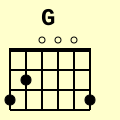
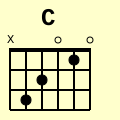
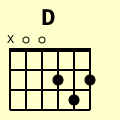
The chord progression for ‘Ode To Joy’ has only three chords.
In the key of C the chords are C, F and G.
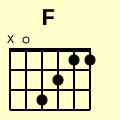
In the key of G the chords are G, C and D.
Add Joy to Your Guitar Repertoire
Not only is this a relatively easy melody to learn on guitar, it has also been a well-known melody for almost two centuries. So if you can play this song as a beginner guitarist, not only will you have fun learning. You will also bring a smile to siblings, parents, grandparents, or spouse, partner or significant other, friends and neighbors.
Why is this important? From my own experience, I started playing guitar at age 14. I received my first guitar from my parents as a Christmas gift (Thanks Mom & Dad). My parents also paid for some initial guitar lessons, and my mother drove me to the music store for lessons. If you can bring a smile to friends and family, even as a beginner, they will know it was worth paying for the guitar or lessons! As a beginner guitar player, they are your “audience”. Keep ’em smiling, and maybe even applauding!
Even if you are an electric guitar player and want to play rock ‘n roll, this is a good tune to learn. Even if you turn up the volume and add some “distortion” EFX (sound effect), this melody will sound cool on electric guitar!
Rock On! Joyously! And with gusto!
2 thoughts on “Ode To Joy: Add some joy to your guitar repertoire”